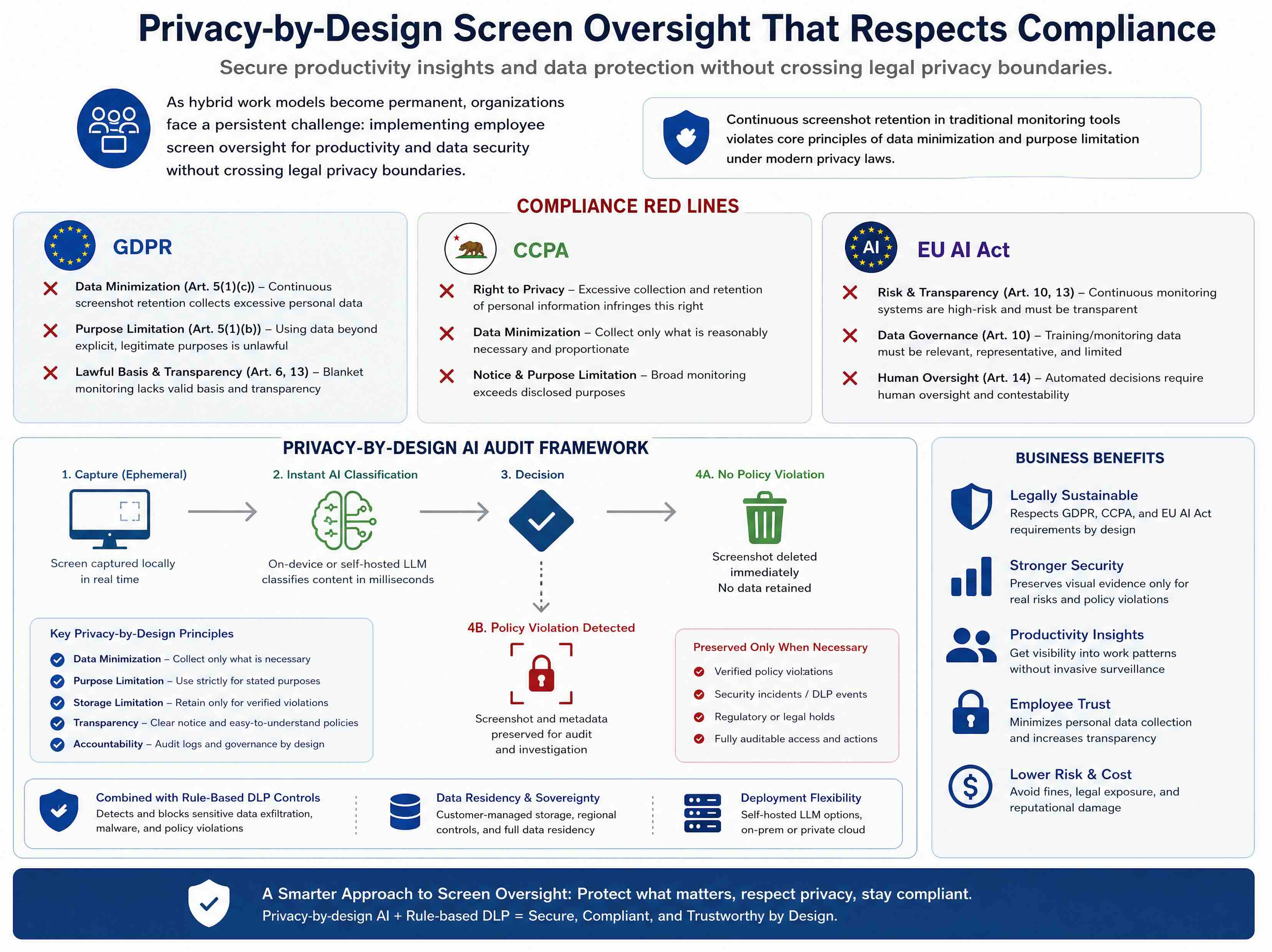
As hybrid work models become permanent, organizations face a persistent challenge: implementing employee screen oversight for productivity and data security without crossing legal privacy boundaries. This article maps critical compliance red lines under GDPR, CCPA, and the EU AI Act, highlighting how continuous screenshot retention in traditional monitoring tools violates core principles of data minimization and purpose limitation. It presents a privacy-by-design AI audit framework that deletes screen captures instantly after LLM classification, preserves visual evidence exclusively for verified policy violations, and enables full data residency via customer-managed storage and self-hosted LLM options. Combined with conventional rule-based DLP controls, this architecture delivers robust endpoint security and productivity insights while minimizing personal data collection, offering a legally sustainable alternative to blanket employee surveillance.
As remote and hybrid work models become permanent, organizations face a growing dilemma: how to maintain productivity visibility and protect sensitive corporate data without crossing legal privacy boundaries. Traditional screenshot-based monitoring tools—with their continuous capture, indefinite storage, and blanket surveillance approach—are increasingly falling afoul of global data protection regulations. This article breaks down the legal red lines for employee screen monitoring, explains how privacy-by-design architecture can resolve compliance gaps, and introduces an AI-powered audit model that achieves oversight while collecting the absolute minimum of personal data.
The Legal Red Lines: What Regulations Actually Require
Employee screen monitoring is not inherently illegal, but its implementation must respect core privacy principles codified across major regulatory frameworks. Violations carry substantial penalties: up to 4% of global annual turnover under GDPR, and class-action exposure under U.S. state privacy laws. Below are the non-negotiable compliance boundaries.
1. Data Minimization: Collect Only What Is Strictly Necessary
Under GDPR Article 5(1)(c), organizations may collect only personal data that is "adequate, relevant and limited to what is necessary in relation to the purposes for which they are processed." Blanket, continuous screenshot capture fails this test because it indiscriminately records everything on an employee's screen—including private messages, banking details, medical information, and personal communications—far beyond what is needed to measure productivity or enforce data loss prevention policies.
U.S. regulators are moving in the same direction. California's CCPA/CPRA automated decision-making regulations (effective 2026) require employers using monitoring systems that inform personnel decisions to conduct pre-deployment risk assessments and demonstrate that data collection is proportional to the stated business purpose. Indiscriminate screenshot archives are increasingly viewed as disproportionate and legally risky.
2. Purpose Limitation and Retention Control
Both GDPR and U.S. state laws mandate that data collected for one purpose cannot be repurposed for another, and must be deleted when no longer needed. Standard monitoring tools that store screenshots for months or years "just in case" violate the storage limitation principle. The UK ICO explicitly advises that monitoring data "must not be kept for any longer than is necessary for your particular purpose" and requires regular retention reviews.
3. Transparency and Lawful Basis
Under GDPR, employee monitoring requires a documented lawful basis—typically "legitimate interest"—balanced against employee privacy rights. Consent is generally not a valid basis in employment relationships due to the inherent power imbalance. Employees must receive clear, advance notice of what is being monitored, why, and for how long.
In the U.S., while federal law (ECPA) generally permits monitoring of company-owned devices for legitimate business purposes, states including Connecticut, Delaware, and New York mandate written prior notification. California extends two-party consent requirements to certain forms of electronic recording and imposes additional obligations for automated systems used in employment decisions.
4. The Emerging AI Act and High-Risk Classification
The EU AI Act classifies AI systems used in employee performance evaluation as "high-risk," requiring human oversight, transparency, risk documentation, and worker notification. Any AI-powered screen audit tool must be designed with these requirements built in, not added as an afterthought.
Privacy-by-Design: How Instant Screenshot Deletion Solves the Compliance Puzzle
The fundamental flaw of conventional monitoring tools is that they treat screenshots as the end product—something to store, browse, and review. A privacy-first AI audit model reverses this logic: screenshots become a transient processing input, not a retained record. Here is how the architecture works at each layer.
Default: Screenshots Are Destroyed Immediately After Analysis
In normal audit mode, the system captures a screen image approximately once per minute, sends it to an LLM for classification (work activity, entertainment, offline), and deletes the original image instantly—typically within seconds of analysis completion. No raw screenshot is written to persistent storage, and no human administrator ever views it.
This design directly satisfies data minimization: the only data retained is aggregated, structured metadata—minutes spent in each category, application names, and domain-level activity logs. The visual content containing personal information never enters long-term storage, eliminating the largest privacy liability at its source.
Crucially, the screenshots are never used to train the AI model. The default LLM provider (Google Gemini) operates under a data processing agreement that excludes customer content from model training, and enterprises retain full control over which model processes their data.
Only Violation Alerts Preserve Evidence
Screenshots are retained only when a preconfigured policy violation is detected—for example, an attempt to transfer sensitive data to an unapproved cloud service, or access to a restricted website. Even then, retention is limited to the specific violation event, not continuous recording.
This "forensic only" approach aligns with regulatory guidance: you keep evidence when you have a specific business reason (investigating a data leak or policy breach), and you discard everything else. Administrators define exactly what constitutes a violation using natural language rules, and the system preserves screenshots only for those triggered events.
Data Residency: Keep Everything Inside Your Own Infrastructure
For organizations subject to data sovereignty requirements or internal security policies, the system supports two deployment paths for alert screenshots:
Customer-managed storage: All violation screenshots are saved directly to the enterprise's own cloud storage (AWS S3, Azure Blob, on-premises object storage) or internal LLM deployment. No data transits or resides on vendor servers.
Vendor secure storage: For organizations that prefer managed hosting, screenshots are stored in encrypted, access-controlled dedicated storage with configurable auto-deletion policies.
Most importantly, enterprises can bring their own LLM—whether OpenAI, Claude, Gemini, or an internally deployed model running on corporate infrastructure. This means all screen content analysis can happen entirely within the customer's security boundary, with zero data leaving the organization. This is a critical distinction from SaaS monitoring tools that centrally process and store all customer screen data.
Beyond Traditional DLP: Combining Access Controls with AI Audit for True Minimized Collection
Traditional Data Loss Prevention tools operate on rigid, rule-based permissions: block USB drives, blacklist websites, restrict application network access. These controls are essential, but they have a well-known blind spot: employees find workarounds. A user can upload confidential files to a lesser-known cloud storage service, share data via personal webmail, or use screen capture tools—all of which slip past signature-based DLP rules.
This is where AI-powered screen audit adds a complementary layer without expanding data collection.
Layer 1: Preventive Access Controls (Traditional DLP)
The foundation remains standard endpoint governance, applied consistently across all devices:
USB read/write control to block unauthorized removable storage
Website allowlisting/blocklisting to enforce acceptable use policies
Application control to prevent unapproved software from running
Firewall rules to restrict network access at the process level
Scheduled policy enforcement by day of week and time of day
These controls stop the majority of risk at the perimeter, reducing the number of events that require visual verification.
Layer 2: AI-Powered Contextual Audit
On top of the permission layer, the AI audit function provides behavioral visibility that rules cannot capture. Instead of continuously recording screens, the system periodically samples activity, classifies it contextually, and discards the visual evidence. Administrators can define "entertainment" or "high-risk" behavior in plain natural language, and the LLM interprets screen content accordingly.
The result is minimized collection by design: you get the productivity and security insights you need, but you never accumulate a database of raw screenshots containing employee personal data. The system knows what category of activity occurred and when, without retaining what exactly was on the screen for normal operations.
This two-layer architecture addresses the core criticism of both traditional DLP (too inflexible) and traditional monitoring (too intrusive). It gives organizations the ability to detect novel data exfiltration paths and measure productive time, while staying on the right side of GDPR, CCPA, and emerging AI regulations.
Conclusion
Employee screen monitoring does not have to be a choice between security and privacy, or between oversight and compliance. What makes the difference is architecture: whether the tool treats screenshots as assets to hoard or as transient inputs to discard.
By combining instant screenshot deletion, violation-only evidence retention, customer-controlled storage, and bring-your-own-LLM flexibility, organizations can implement meaningful screen audit and productivity measurement while honoring data minimization, purpose limitation, and employee privacy rights. In an era of tightening regulation and growing employee privacy awareness, this is not just a better technical approach—it is the only legally sustainable one.