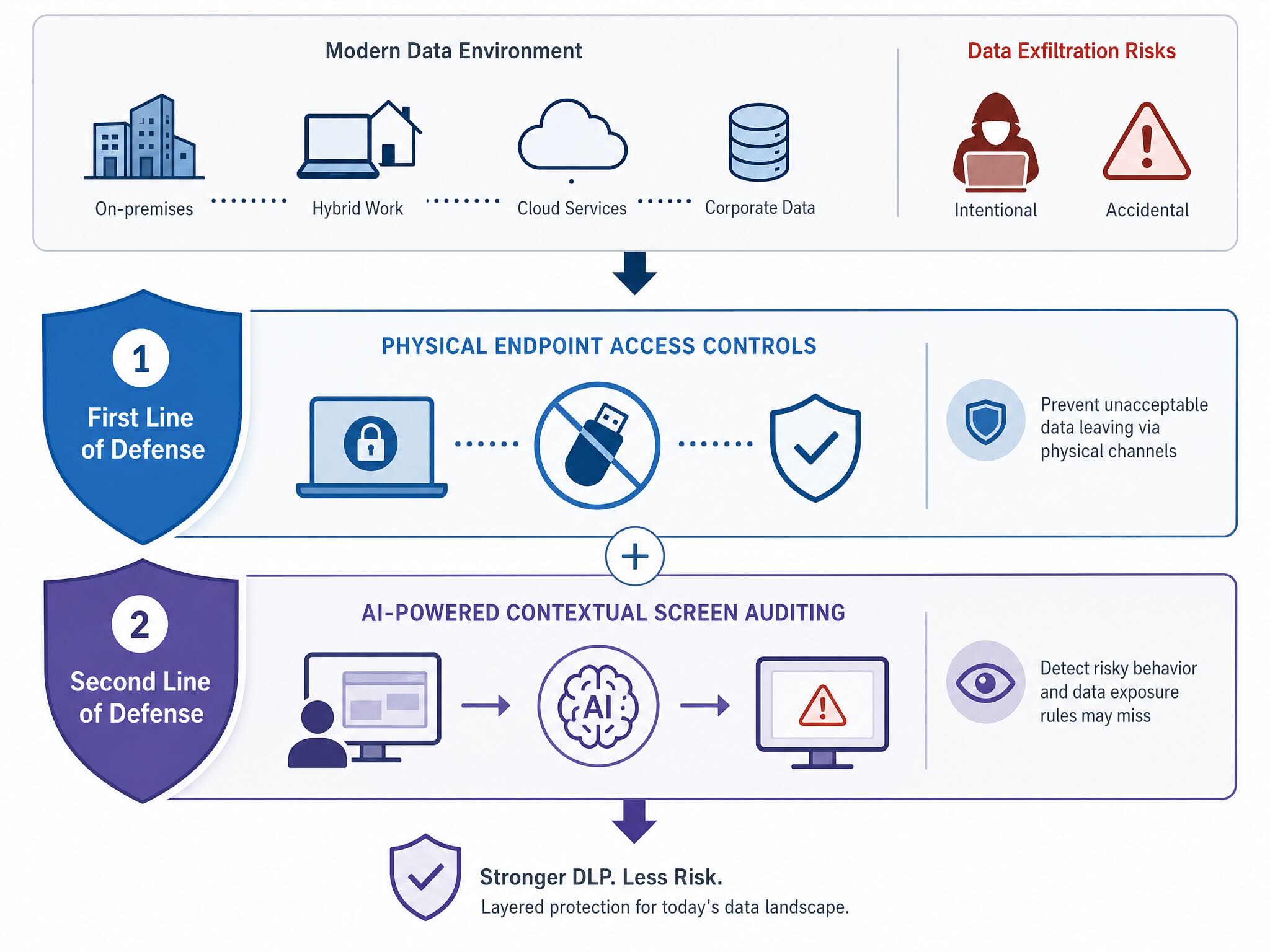
Traditional USB device control forms the essential first layer of enterprise data loss prevention, blocking physical data exfiltration via removable media alongside rule-based web, application, and network controls. However, rigid signature-based DLP systems cannot cover the full range of modern leakage channels, from unlisted cloud services to screen-based data transfer. This article presents a two-layer defense framework that pairs foundational USB and endpoint controls with AI-powered screen auditing. The AI layer uses large language models to detect contextual policy violations that evade static rules, while preserving privacy through instant screenshot deletion, violation-only evidence retention, and support for customer-hosted models and storage.
For decades, USB device control has been the cornerstone of on-premises data loss prevention strategies. As corporate data spreads across hybrid work environments and cloud services, however, perimeter-only controls are no longer sufficient to stop intentional and accidental data exfiltration. A modern, robust DLP strategy requires a layered approach: physical endpoint access controls as the first line of defense, paired with AI-powered contextual screen auditing as the second safety net for gaps that rigid rules cannot catch.
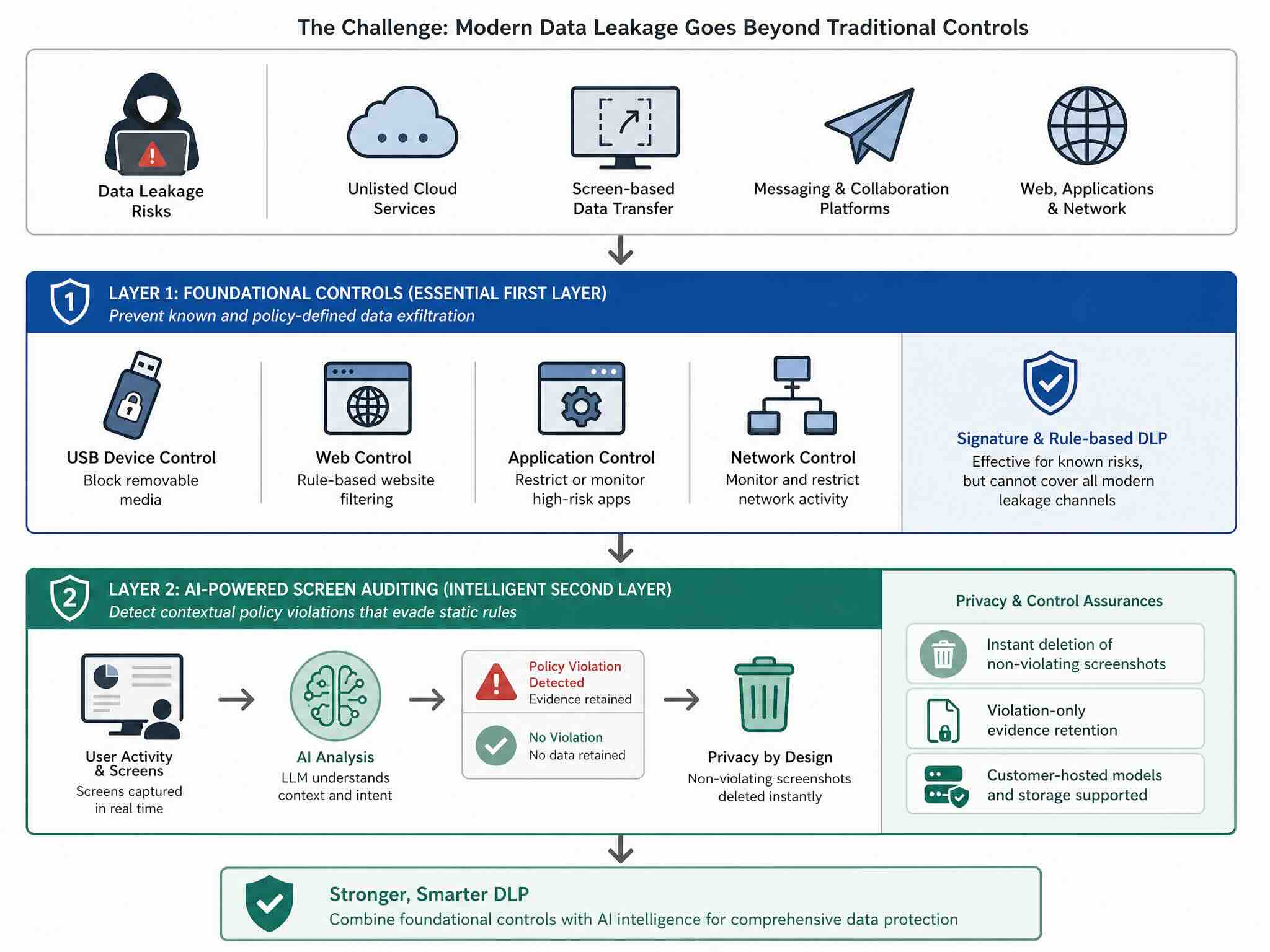
Layer 1: USB Access Control — The Foundational Physical Defense
USB and removable media remain one of the most common vectors for data theft and malware introduction, making endpoint device control an indispensable baseline for every organization. Administered via a centralized web console, granular USB read/write policies allow IT teams to block unapproved storage devices entirely, restrict access to read-only mode for authorized hardware, and log all USB connection events.
This foundational layer is complemented by additional rule-based controls that form the core of traditional DLP: website allowlists and blocklists to regulate web access, application whitelisting to prevent unapproved software from running, and network-level firewall rules to control which programs can access the internet. Combined with time-based policy scheduling that enforces rules by day and hour, these controls block the majority of known, predictable data leakage paths at the source. They are proactive, low-overhead, and highly effective against standard threats.
Why USB Blocking Alone Is Not Enough
The critical limitation of rule-based DLP is that it only stops what administrators already know to block. In practice, employees seeking to transfer data outside the corporate network have countless workarounds that fall outside predefined signature lists.
Sensitive files can be uploaded to lesser-known cloud storage services, personal webmail accounts, temporary file-sharing platforms, or collaborative workspaces — none of which may appear on a standard blocklist. Data can also be exfiltrated via screen captures, copy-paste into browser forms, or even photo capture of the screen. None of these channels are stopped by USB restrictions, and most evade traditional keyword or pattern-based DLP filters. Relying solely on perimeter controls leaves organizations blind to novel, low-signature leakage paths and creates a false sense of security.
Layer 2: AI Screen Audit — The Contextual Safety Net
This is where AI-powered screen auditing fills the gap as a second, intelligent layer of defense. Instead of trying to block every possible exfiltration channel in advance, the system periodically captures screen content and uses a large language model to interpret activity in context.
Administrators can define risky or prohibited behaviors in plain natural language — for example, "uploading confidential documents to unknown cloud drives" — and the LLM will classify and flag matching activity as it appears. Screenshots are captured approximately once per minute, analyzed immediately, and permanently deleted right after processing under normal conditions; only images associated with confirmed policy violations are retained as evidence.
For maximum security and compliance, enterprises can route all analysis through their own LLM provider (OpenAI, Claude, or Gemini) or an internally deployed self-hosted model, with all alert screenshots stored in the company's own designated storage. This ensures no sensitive screen data ever leaves the corporate environment, closing the DLP coverage gap without expanding privacy risk.
Together, these two layers create a defense-in-depth architecture: rule-based USB and network controls stop most common threats upfront, while AI contextual audit catches the edge cases and novel exfiltration methods that rigid rules miss. The result is stronger data protection, broader visibility, and a privacy-respecting design that aligns with global data protection regulations.